The Parting of Heaven and Earth

Chapter 1

The Parting of Heaven and EarthTenchi Kaibyaku

Out of primordial chaos, heaven and earth divide.

◀ Back to Contents
This retelling is a heavily condensed, dramatized modern version of the original Kojiki. Some episodes are omitted and wording is simplified; please consult the original text or scholarly translations for accuracy.

In the beginning heaven and earth were not yet separated, and the world drifted formlessly—like oil floating on water, like a jellyfish adrift. In time the clear, light element rose to become heaven, and the heavy, murky element sank to form the ground.
The Parting of Heaven and Earth

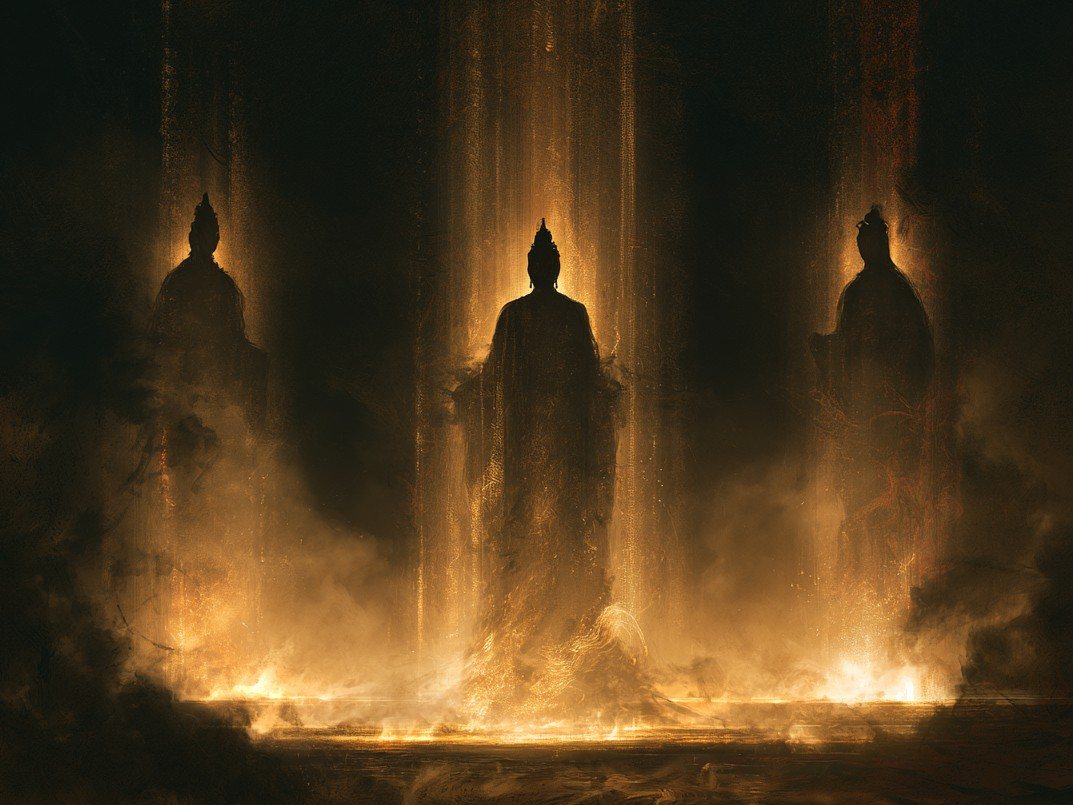
At that moment, in the High Plain of Heaven (Takamagahara), three deities came into being of their own accord: Ame-no-Minakanushi, the central lord of the heavens; Takamimusuhi; and Kamimusuhi. Together they are called the “Three Deities of Creation.”
The Parting of Heaven and Earth

All three were solitary gods—born without a partner—and, having appeared, they quietly hid themselves. The world was still unformed, and the great story of the gods was only beginning to stir.
The Parting of Heaven and Earth

Deities in this chapter

Ame-no-Minakanushi
天之御中主神
The very first deity, lord of the center of the cosmos; foremost of the three creator gods.
Takamimusuhi
高御産巣日神
A god of ‘musuhi,’ the generative force that brings things into being; a guiding power of Takamagahara.
Kamimusuhi
神産巣日神
Another deity of the generative force, associated especially with regeneration and revival.

Background & Trivia

What ‘musuhi’ means
‘Musuhi’ is the power by which life is generated and grows—the same root behind words like ‘musubu’ (to bind) and even ‘musubi’ (a rice ball).
Solitary gods
The earliest deities appear as ‘hitorigami,’ solitary gods without a male–female pair—pure forces that existed before the machinery of birth was in place.
Share this chapter✕ PostLINEFacebook